Sunday, March 1, 2015

Cabin Fever

According to the schedule, last week we should have planted spinach, peas and radishes outside. Last year at this time, we had already started spinach and peas outdoors.  Good lesson for gardening (and life, I suppose): every year is different.  The weather has been wildly uncooperative this winter for both gardening and bike commuting.  Here is a picture of our garden as of this morning:

Snow-covered backyard and garden - March 1, 2015
The good news is that we will probably have a shorter wait for peas once we get them outdoors, since this year we started them inside:
Peas: one is already blooming
Last year the peas took 90 days from planting outdoors February 21 until the first harvest. This year, since we planted indoors in January, we should expect to start harvesting about a month earlier or possibly more, since we've given our peas a head start with the artificial lighting and heating pad.

As we wait for the snow to melt and the soil to thaw, we've been busy planting and replanting inside. We moved tomatoes, kale, broccoli, cabbage, cucumbers from the small tray to individual pots:


We've planted basil, peppers (cayenne, jalepeño, bell), and eggplant in the small tray over the last few weeks. Once we can move the hardier plants outside we'll transfer the new batch to individual pots and wait for the last frost (around April 10 with 90% likelihood according to the University of Virginia Climatology Office). 

The outlook from the National Weather Service looks promising for above freezing temperatures, if not ideal for biking.  Maybe we'll be able to update next week on outdoor planting.

Alexandria, VA forecast for the week of March 1


Monday, February 2, 2015

Back in Business

It's cold, wet, and windy outside, which means one thing: it must be time to start our 2015 garden!

Peas seven days post-planting

The beginning of this planting season is all about acting on lessons learned from last year. For example, some of our plants didn't hit their stride until too late in the growing season, resulting in low yields.  So this year we started kale and eggplant in the first round and plan to harvest them in late April and July, respectively. 


Organizing the seeds so we can remember what we planted

All the tools - bucket of home grown dirt on the right

Seeds in - ready to put under the light

Another difficulty we have growing inside is a lack of natural light and cool temperatures - it is usually around 62 F in the back room where the plants are, but seeds like to germinate at temperatures between 70 and 80 F.  Without turning up the heat and doubling the gas bill, we decided to get a heating pad for the plants and an industrial size LED light on a timer.  Roger's dad was in the process of retrofitting his farm with LED lighting - something that will result in huge energy savings for his business - and was nice enough to send us one of the 4-foot LED lights for our little experiment.  

Putting old textbooks to good use
Heating mat
The heating mat gets the soil temperature up in the 70-80 F range, ideal for most seeds (if we wanted to be precise, we would move peppers to separate pots and heat them up to 85 F, but we'll see how this works for now).  The light is timed to turn on at 5:30 AM and off at 8:30 PM, simulating a longer growing day.

Anecdotally, these measures seem to be making a difference already, although I don't have measurements to back that up.  These are pictures taken 7 days after planting:

From front to back: 2 rows kale, 2 rows tomatoes, 2 rows cucumbers, eggplant/peppers, broccoli, 8 rows peas

Left to right: peas, broccoli, cucumbers


Saturday, January 31, 2015

The 2015 Garden Plan

New year, new plan for the garden!  We've changed up what we're planting this year, and where everything's going.  Last year we learned some key lessons the hard way:
  • You reaaallly only need 2 or 3 jalapeño plants, or else you'll be force feeding jalapeños to your friends, neighbors, and random people you pass on the street.  Seriously we had about 10 lbs of jalapeños from the 4 plants we grew last year.
  • Last year we got a little over-excited and planted too much stuff, resulting in a jungle of tomatoes and beans that we couldn't hack through.  We ended up not picking a lot of veggies because we couldn't reach them, and they smothered other things we tried to grow, like swiss chard
  • We could have planted a lot more spinach and other early spring veggies.  This year we're going nuts with the spring veggies, and starting them a lot earlier
So without further ado (drumroll), here's the Official 2015 Garden Plan!!


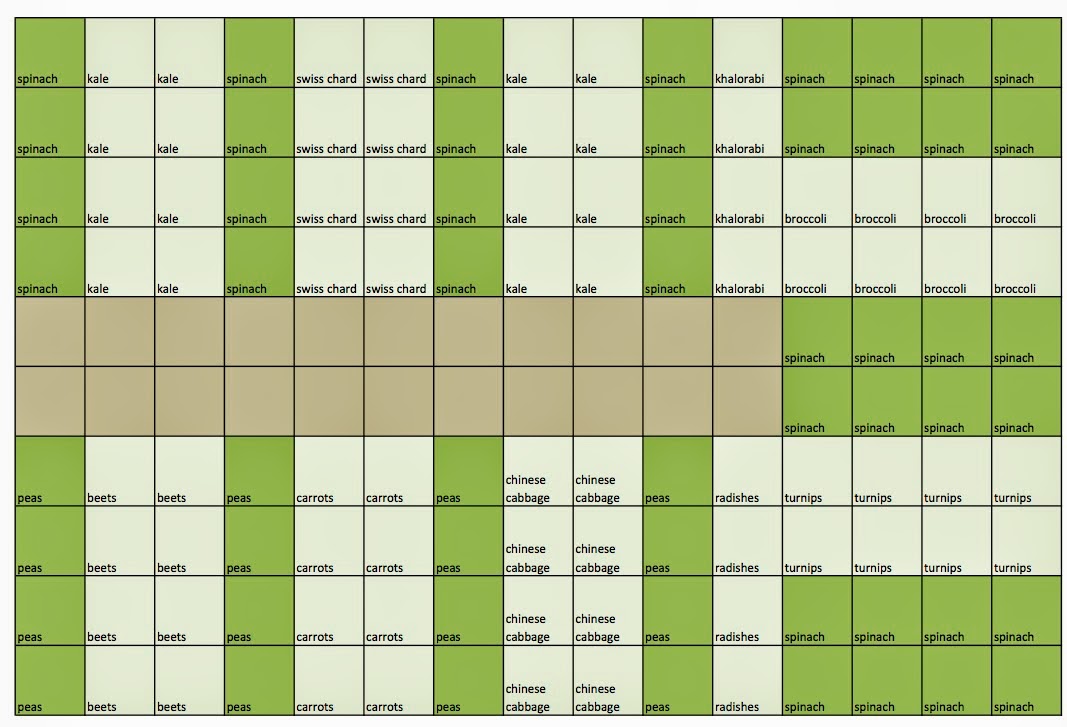
The biggest change this year is that we're going to try and do two major plantings: an early spring crop and late summer crop.  The spring layout shows a lot of peas, spinach, kale, and other cold weather crops.  Then around early/mid-May, we'll switch to the Summer layout!

Just like last year's layout, each square is one square foot of our garden.  The brown squares is the footpath.  The dark green squares are where the trellises will go.

Spring Layout

Once summer rolls around, we get to the good stuff: tomatoes, cucumbers, eggplant, peppers, etc all growing on the trellises!  A lot of the non-trellis plants (carrots, kale, cabbage) stay the same year round.

Summer/Fall Layout


One last thing - here's our predicted yields.  They seem wildly high to me, but we'll see what happens!  Anyone know what to do with 70 lbs of beets??


* Yield estimates are from here: http://commongroundkalamazoo.com/images/YieldCalc.pdf and a few other sources I found on google.


Saturday, October 25, 2014

Last Harvest

The first frost of the season should be here any day now, which means it's time to harvest most of the remaining vegetables. Here is a recap of today's harvest:

  • The Brussels sprouts were a complete bust. Bugs have eaten all the sprouts and I'm really disappointed about it.  No pictures because it's too sad.
  • Kale is not doing much better, but we are going to keep that in the ground because it is frost resistant.
  • We got a huge new batch of cayenne peppers! They are now strung up in another south facing window.
Just picked from the garden

42 cayenne peppers in total


From an earlier harvest of peppers; took about a month to get this red

  • Bell peppers have stopped turning red, so I picked the rest of the green ones.  Healthy snacks all week!

  • What in the world are we going to do with all these flipping jalapeños?? 2.5 lbs. We already pickled 5 lbs of these, and there is no way I'm doing that again (will have to post on that later). We've been making a LOT of jalepeño poppers, but you can only eat so many of those in one sitting before feeling like you are permanently damaging your esophagus lining.  The good news is that these stay fresh a really long time, so we can probably draw this batch out through December.  Any jalepeño recipe or preservation ideas?

  • And finally, I just picked the rest of the eggplants and cherry tomatoes. Those green things are the few sad little kale leaves that were ready.  See all the holes from where bugs are eating them?  Arg!  The good news is that eggplants are good to eat at just about any size, so you can either wait all those weeks and get a huge eggplant (enough for one eggplant parm), or just pick the little ones and use them for other things.  I'm going to try to make eggplant chips with these - I'll report back in another post.

Stay tuned for recaps on more vegetables and some future work on getting the garden ready for winter!

Monday, September 22, 2014

It's getting hot in here (so hot)

One of the biggest surprises of the season was cayenne peppers.  The plants took the longest time to germinate, and then only a few survived long enough to be transplanted outside.  One went up on our deck and one was planted among the jalepeños.  

I didn't take much notice of these plants while we were bringing in loads of cherry tomatoes, beans, bell peppers and jalepeños.  Then one day we were on the deck and noticed a long green pepper hanging from one of the pepper plants.  Upon closer inspection downstairs, the plant was actually pretty full of peppers ready to be picked, they were just the exact same color as the rest of the plant, so we weren't noticing them:

How many peppers can you spot?

We probably took about 20 peppers off the plant that day:

Not wanting to find ways to eat 20 cayenne peppers right away (our digestive systems probably thanked us), and also not wanting to burden our neighbors with even more spicy pepper give aways (more on how we are testing the limits of friendship by pushing jalepeños on neighbors, friends and relatives in a future post), we looked to alternatives.

Our friends Luther and Tina are experienced cayenne pepper dryers, and we took their advice.  I didn't take any how-to pictures for this, but it's exactly what it looks like: take a needle and thread and string the peppers together, hanging them from a wall or window frame.  The pictures show roughly weekly progression of drying/reddening for the cayennes:


Just to get the whole picture, we have two more strings this size in other locations around the house, and will probably double that judging by the number of peppers still growing on the plant today.  And this is just from the one plant that survived in our garden!  The other plant just popped out that single pepper and died (we didn't pay very close attention to our roof plants, so that's our fault).  Moral of the story:  one healthy cayenne plant is all you need unless you're planning on opening a sriracha factory.

So now the next step is figuring out what to do with a bunch of dried cayenne peppers.  We could grind them up into a powder (I'm not sure if they are dry enough for that yet), or freeze them.  Any other suggestions?

Thursday, September 11, 2014

TBT: watching the garden grow

Throwback Thursday!  It's hard to believe the garden ever looked neat and organized.  Scroll through the pictures to see what I mean.  Let's take a look back to April, when outdoor planting began:

Colt poses in front of the newly created garden

Front rows: spinach, back row: sugar snap peas

Artsy angle

Cabbage on the right, tomato seedlings in the back left, Brussels sprouts back right

Cucumbers...these did not turn out well, probably because the tomatoes completely blocked their sun after a few weeks


Growing!  Flowering plants are summer squash.  Those grew like weeds.

Cabbage starting to look cabbag-y


View from above

Woah!  I let it go too long between pictures here...About now we're realizing why cabbage said 3 ft between plants. 

Ok, what is happening here.  There was at least a two month window between this picture and the previous one.  Most of the cabbages have been harvested and we planted jalepeños and bell peppers in their place.  Eggplants went in next to the Brussels sprouts, the snap peas have died but string beans have taken their place, and the summer squash is making a play for the patio.

You can actually see some cherry tomatoes from this picture!  It is also starting to look like a jungle.

We just took out the summer squash last week and tried to trim back the tomatoes and peppers.  
Tune in next week for some plant-level detail!


Monday, September 8, 2014

Let's talk about Brussels sprouts

One of the vegetables I was most looking forward to growing and eating was Brussels sprouts.  Growing up we never ate them, probably because our mom assumed we would fall under the tired "kids don't like Brussels sprouts" trope, or maybe she didn't like them herself.  Either way, I never remember eating them until I was grown, and got them as part of a CSA a few years back in Pittsburgh.  The CSA helpfully sent out recipes each week, and for Brussels sprouts the recipe basically went like this - slather in olive oil, sprinkle with sea salt and fresh ground pepper, add a spritz of lemon juice (optional), and roast at 400 F.  You really can't go wrong with roasted vegetables, and I was hooked.

Fast forward to January of this year, and Roger and I decided to dedicate a solid 16 sq ft of garden space to Brussels sprouts.  We diligently planted the seeds indoors on January 25, according to the plan, and moved them outside in April.  

Top right 4x4 squares are Brussels sprouts
Transplanting
After another two months, those little seedlings started to look like this:


 Things were moving along swimmingly, or so I thought.  We started to notice some pest damage on the leaves, and closer inspection gave way to a frightening discovery:

Eggs!!!!
 
Pest damage (can you find the pest?)
Some type of caterpillar thing, I think in the process of laying an egg.
We've tried a few things to get rid of the pests and keep them from returning:
  • Soapy water
  • Concoction of coffee grounds, garlic, onions, and cayenne pepper powder, marinated overnight
  • Trying to avoid standing water on the leaves, so only watering at the base of the plants
All of these have had some success, but problems remain.  I haven't seen the caterpillars in a while, but now there are some tiny white bugs that live on the plants.  The standing water was less of a problem when summer was in full swing, but now that September is here it might return.  Compounding the problem is the sprouts are planted in the most shady area of the garden, limiting their growing potential and keeping things damp.

According to our research, the Brussels sprouts should have been ready for harvest June 4.  It is now over two months later, and we are not that much closer. 

This little guy has the most shady spot in the garden.  I don't have much hope that the sprouts will fully form before winter.


These are some of the most mature sprouts, but still not full-sized.  I hope to get at least three full stalks before the first frost.

The whole Brussels sprouts patch is kind of a mess.  

The sprouts started falling over on each other once they got tall enough.  A few have died.  Three or four look like they might produce a full stalk of sprouts before the season is over.  Maybe we planted these too close together, and definitely not in full enough sunlight.  I'll make another Brussels sprouts update later in the season.  Lots of lessons learned for next year!